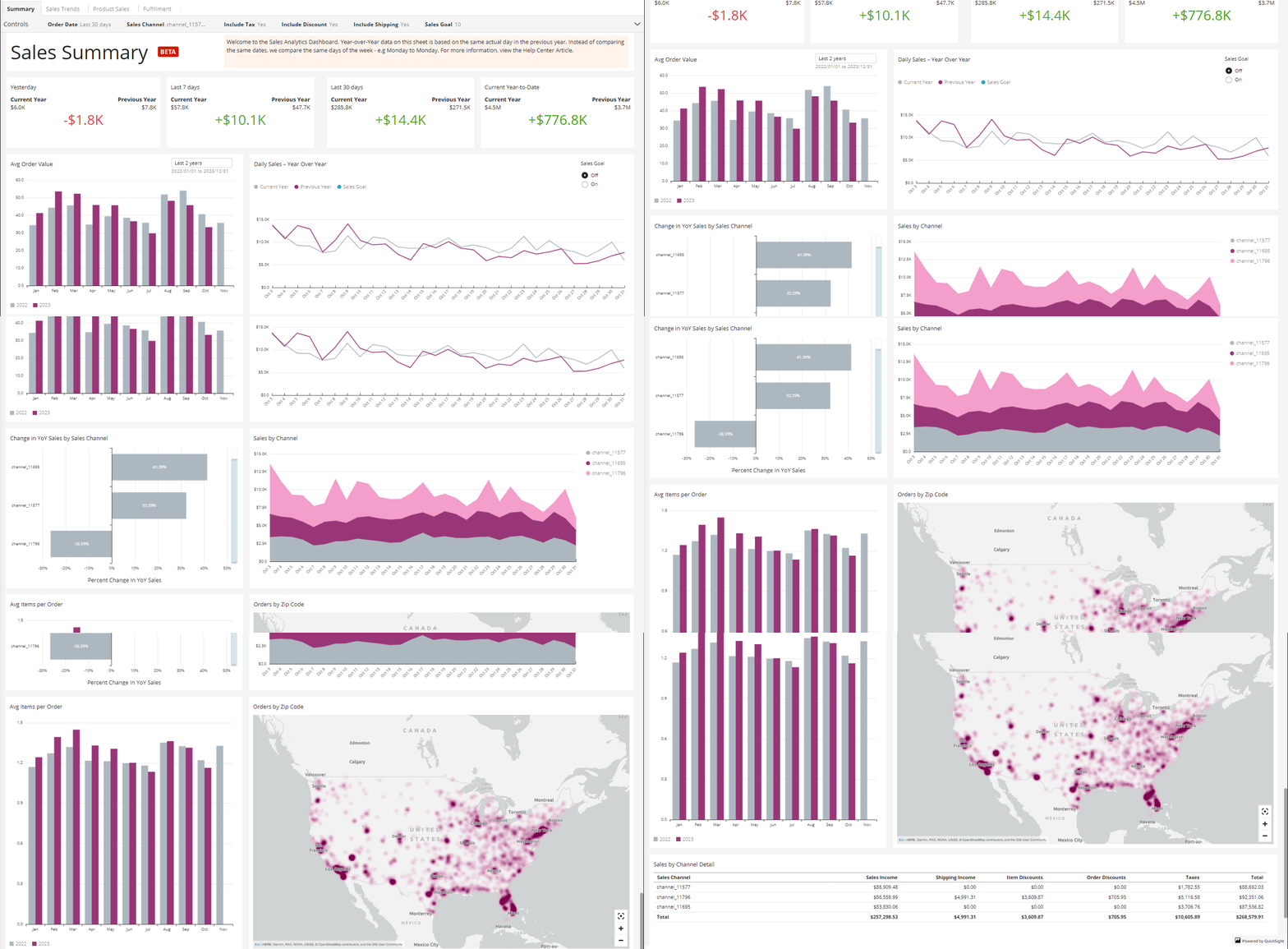


The modern warehouse is the heart of business growth - rather than just a place to store goods.
For 3PLs, it’s also where you prove value to every client you serve - where optimal handling, clean execution, and consistent performance set the stage for faster, more accurate distribution.
To deliver that consistency, operations teams need unified end-to-end data views. That’s why advanced warehouse analytics has become the key tool for improving daily execution, reducing costs, and enhancing satisfaction for both shippers and their end customers.
Such data empowers 3PLs to shift from reacting to anticipating, protect SLAs, reduce chargebacks, and build a clearer operational story for QBRs and renewals.
4 Ways Analytics Is Transforming 3PL Warehouse Management
In today’s interconnected era, visibility is the key to success. The rich insights provided by WMS analytics transform the way 3PL warehouses operate at every level:
1. Optimize Warehouse Operations
Detailed data helps 3PLs streamline inbound/outbound flows, manage stock wisely, track productivity by activity, and improve workflows. Plus, real-time information makes it easier to monitor KPIs and respond quickly to small deviations before they turn into bigger problems.
2. Improve Inventory Management
Predictive analytics balances supply by forecasting demand patterns and expected volume swings - thus avoiding shortages and excess stock. Beyond quantities, it also shapes physical storage within the 3PL warehouse by optimizing item placement for space and faster fulfillment.
For example, slotting high-velocity SKUs closer to pack-out zones reduces travel time, which boosts pick rates, cuts fatigue from unnecessary walking, and lowers labor cost per order.
3. Drive Process Automation
WMS reporting and analysis highlight tasks that take too long or are error-prone. By automating repetitive tasks, businesses can speed up cycles, improve consistency, and eventually cut down on costs. In a 3PL environment, automated warehouses are more likely to maintain order accuracy of +99%.
Moreover, once processes are automated, they feed new data back into the system, further benefiting operations by improving forecasting, staffing, and exception management.
4. Integrate Disparate Data Sources
Advanced WMS analytics bring together data from ERPs, order management systems, transportation tools, EDI feeds, and client portals. That creates a more complete operational picture so logistics service providers can better plan shifts, schedule shipments, and prioritize work based on client rules, carrier pickups, and service commitments.
Benefits Of Warehouse Reporting And Analytics
For 3PLs, applying data analysis boosts efficiency across the warehouse and beyond.
Happier Customers
Because warehouse data analytics enables network-wide tracking of inventory along with order fulfillment and shipping milestones, you can ship more orders, with higher accuracy and on-time rates.
This improves end-customer satisfaction and reduces the escalations that land on your team when something goes wrong.
Higher Profitability
Analytics exposes wasted resources and inefficiencies. In fact, 60% of users cite process improvement and cost control as their top reasons for using it.
And, as efficiency improves, so does profitability.
For a 3PL, that often shows up as fewer rework touches, better labor planning during peaks, and tighter control of cost per order or cost per line, without sacrificing SLA performance.
Optimized Space Utilization
Analytics reports highlight gaps in workflows and asset utilization, such as wasted storage space or inefficient warehouse layouts.
With AI-driven slotting algorithms, organizations can, for instance, optimize storage placement and cut unnecessary worker movement that leads to extra fatigue, longer task times, and higher operating costs.
This matters even more in multi-client environments where the mix of SKUs and velocity changes month to month.
Better Planning
Analytics helps 3PL teams rely on facts instead of guesswork. By analyzing historical data, including trends, seasonality, and client-specific patterns, you can plan for growth, make better capacity decisions, and justify operational changes with confidence during client reviews.
Faster Fulfillment
Predictive analytics shrinks fulfillment time by forecasting demand and workload, helping you plan labor, replenishment, and capacity before spikes hit. Warehouse reports further break down accuracy, returns, and exception reasons, enabling you to uncover root causes and fix them at the process level.
Meanwhile, real-time dashboards give operations teams visibility into critical KPIs like dock-to-stock time, pick rate, and OTIF (On-Time In-Full), exactly when they need them.
Challenges With Warehouse Management Analytics
Because implementing sophisticated warehouse analytics systems is not without its hurdles, 3PLs should address emerging challenges early on to stay on track.
Data Quality & Complexity
In Extensiv WMS’s words: “Bad data in, bad data out. Efficiency and accuracy start at the receiving dock.”
Put simply, when warehouse data is messy, incomplete, or inaccurate, insights lose their value.
This is especially risky for 3PLs, as faulty data can lead to billing disputes, inventory discrepancies, and SLA misses.
Using trusted software and regular data checks keeps lasting success within reach.
Integration With Legacy Systems
Warehouse data is frequently spread across numerous disparate systems and platforms. On top of that, many old systems may lack the capacity to integrate smoothly with modern analytics tools. The result? Data silos pile up, and analysis drags.
It’s also worth mentioning that last year alone, 39% of enterprises surveyed across industries cited integration complexity as their primary challenge in deploying data warehouses. For 3PLs, the challenge is often amplified by client-specific tech stacks and onboarding variability.
Skill Gaps & Talent Shortages
Operational analytics and basic statistics are the foundational skills required for effective data analysis in the warehouse.
However, the logistics and supply chain sector faces a significant “literacy gap,” which limits organizations' ability to fully leverage their data for actionable insights.
The practical fix is usually a blend of better tooling, consistent KPI definitions, and operational training that helps 3PL ops teams turn dashboards into daily decisions.
Cost & Investment
For a full-scale data warehouse, setup costs can be steep. Beyond licensing, there are infrastructure expenses, ongoing maintenance fees, and added expenses for installation, implementation, upgrades, and expansion.
On a brighter note, cloud-based analytical solutions, such as the Extensiv WMS platform, offer a more flexible and scalable alternative, which can be a better fit for 3PLs that need quick time-to-value and low-friction deployment across multiple sites.
Tools And Techniques In Warehouse Management Analytics
Warehouse management analytics is powered by a combination of software platforms, computational techniques, and hardware devices for processing and visualizing operational data.
Warehouse Management Systems (WMS)
The WMS acts as the central hub for modern warehouse operations, collecting comprehensive data on inventory levels, labor performance, and the movement of goods.
On the front end, platforms like Extensiv offer user-friendly dashboards and workflows for receiving, picking, packing, shipping, and returns.
WMS Analytics & Reporting
Advanced warehouse management platforms combine detailed reporting with WMS analytics to track performance and optimize workflows, often with filters for client, workflow type, order channel, or service level to isolate issues by account and protect SLAs.
WMS Dashboards
Robust solutions offer real-time dashboards for live insights into core KPIs like fulfillment cycle time, backlog, picking accuracy, and inventory integrity. The visual interface of a WMS dashboard makes complex data easier to understand, enabling quick managerial adjustments whenever needed.
Supply Chain Planning (SCP) Tools
These tools elevate inventory planning beyond the WMS. They support demand forecasting, replenishment planning, supplier performance tracking, and inventory analysis.
Plus, they integrate with ERP, WMS, and 3PL fulfillment systems for more complete data alignment across the network.
Data Visualization
Turning data into graphs and visuals makes it easier to identify patterns across reports and dashboards, compare trends by client, and prioritize operational actions.
Predictive Analytics
Predictive analytics forecasts outcomes, such as demand surges or labor needs, using machine learning and statistical modeling based on historical data and seasonality.
Mobile Scanning & RFID
Technologies like barcode scanners and RFID (Radio-Frequency Identification) tags automate data capture and provide real-time tracking of granular, item-level inventory movements. Specifically, Extensiv WMS supports inventory management that reaches up to 99.9% accuracy.
Sensors & IoT
Sensors gather real-time data on warehouse activity, asset utilization, and environmental conditions.
The Internet of Things (IoT) connects automated systems and smart devices to deliver operational insights and support predictive maintenance in a 3PL facility, while tracking conditions like temperature and humidity when needed.
Elevating Strategy With Extensiv Analytics
As 3PLs rely on data-driven execution to protect SLAs and retain clients, a unified system for collection, processing, and visualization is no longer a luxury. It’s a necessity, and Extensiv provides exactly that.
An integrated, cloud-based platform that transforms operational hurdles into streamlined efficiency, offering one trusted source of truth across clients and workflows.
With the Extensiv Reporting & Analytics tool, you gain practical insights to apply across your warehouse operations - moving beyond summaries to informed decisions that support accuracy, profitability, and stronger client relationships.
Ready to turn your data into a winning edge? Request a demo today!
FAQ - Warehouse Analytics Definition
Here’s a concise definition of warehouse data analytics:
What Is Warehouse Data Analytics?
Warehouse analytics (or warehouse data analysis) is the practice of collecting, analyzing, and interpreting data from across warehouse operations to generate insights that guide decisions.
For 3PLs, this is what turns day-to-day performance into client-facing accountability and turns operational noise into actionable levers.
The Role Of The WMS In Warehouse Analytics
Orchestrated by the WMS (Warehouse Management System), analytics and reporting bring together data from seemingly separate, physically distant sources and turn complex figures into clear, useful knowledge, across receiving, putaway, picking, packing, shipping, and returns.
From Metrics To Momentum
True, if you only look at raw information - from stock levels and staff performance to order accuracy and carrier cutoffs - you’ll probably feel overwhelmed.
However, analysis changes that into practical value: with strong warehouse operations analytics, managers see the true state of their facilities at a glance and in real time, even across multiple clients, profiles, and workflows.
-
You’ll read about:

Be the first to know
Subscribe to our newsletter